[Wonder what DEON means? And how Plato uses the word?]
(Follow us at PI’s linkedin https://www.linkedin.com/in/george-c-9a772364/ – PI’s short bio and full CV here)
Neuroscience has made amazing discoveries. We now have the unprecedented ability to observe, record, analyse and even predict the human brain and body in vivo, sometimes 24/7 (see wearable technology) with millisecond accuracy.
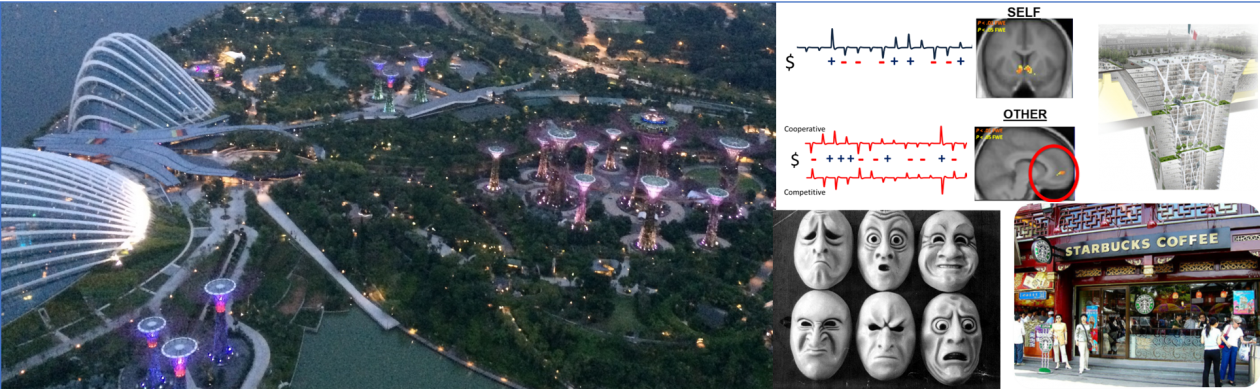
Our aim is to introduce these extraordinary insights, concepts, theories and methods to disciplines that have not still appreciated this scientific revolution. These include architecture and engineering (urban neuroscience); decision making in management and business sciences , economics and education; aesthetics and culture.
Decision making is a central concept across almost all sciences studying human behavior. Our research covers the following interconnected topics (fig. 1):
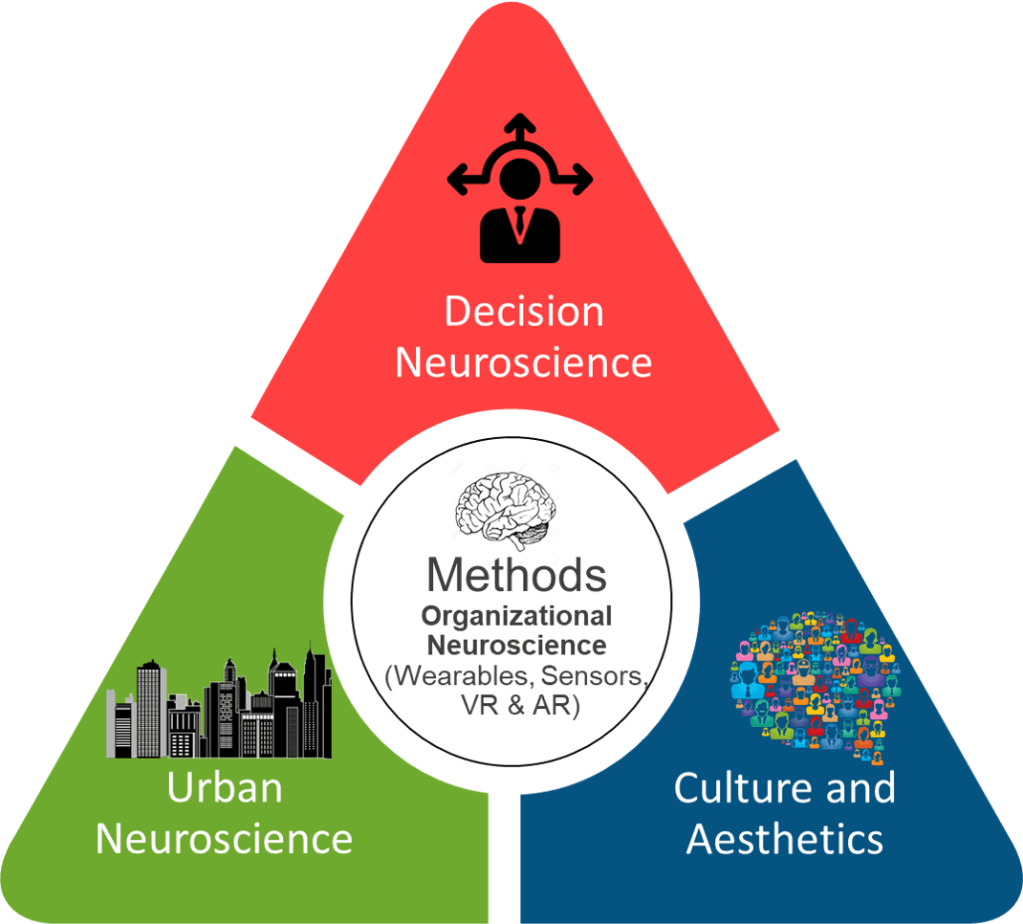
- Environmental (Urban) Neuroscience: we focus on the effect of indoor and outdoor spaces, and their architectural characteristics on human performance, health and happiness. A recent grant examines the effect of soundscaping and sounds on human cognition
- Organizational Neuroscience / Methods for Organizational Neuroscience: We want to introduce rigorous neuroscience and experimental methods to organizational research. To that extend, our lab is leading the Methods Section of the Academy of Management Organizational Neuroscience (NEU) Group. Our research agenda combines the two research traditions of decision theory and cognitive neuroscience. Methodologically, we employ behavioural methods derived from psychology; computational methods stemming from game theory, learning theory and microeconomics; and biological measurements such as human neuroimaging using functional Magnetic Resonance Imaging (fMRI), physiology (skin conductance), eye tracking, wearable technology and EEG, whereas we have been adapting Virtual Reality and Wearables for human research. See ResourcesHuman learning and decision making ([entrepreneurial] trust, risk and cooperation, competition,), with a focus on cognitive flexibility and computerised training of working adults
- Culture, Beauty and aesthetics: deeper beliefs about beauty and how they affect consumption of cosmetics; and how culture and cultural symbols (statues, images, buildings) affect emotions as well aesthetic and other judgments;
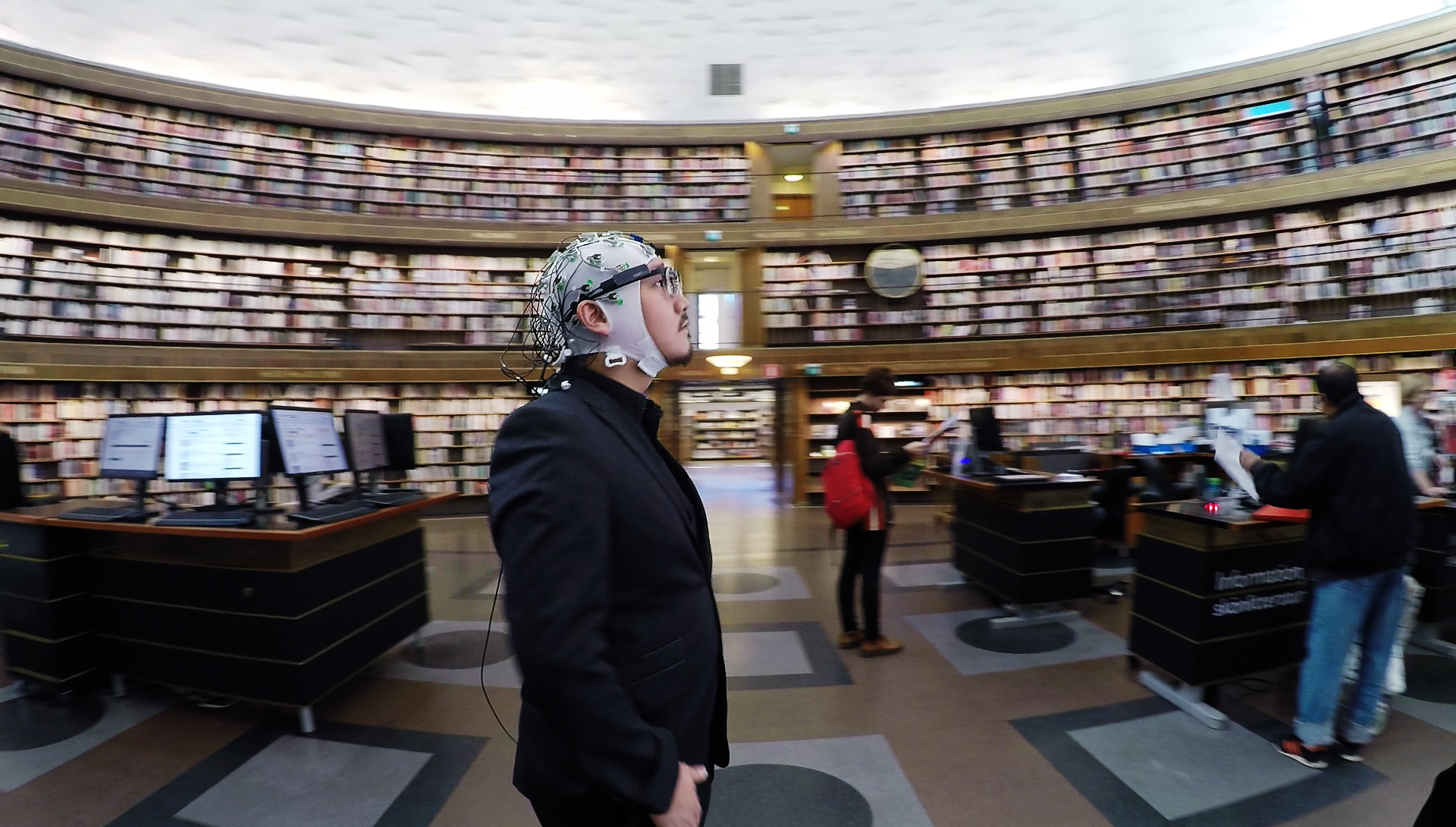
(Elliot Chan testing synchronised eye-tracking and EEG at a library at Norway)

Our aim is to uncover, explain, predict and improve human choice behavior.
***********************
*Some notes about our name:
deon: in Greek δέον, is the root word for Deontic:
Simply put, δέον means the ‘one that has / is right to be done’, the ‘ought being’, but formally:
deontic [diːˈɒntɪk] adj
(Philosophy / Logic) Logic
a. of or relating to such ethical concepts as obligation and permissibility
b. designating the branch of modal logic that deals with the formalization of these concepts
Collins English Dictionary – Complete and Unabridged © HarperCollins Publishers 1991, 1994, 1998, 2000, 2003
Plato used δεον in The Statesman (284E):
..ὁπόσαι πρὸς τὸ μέτριον καὶ τὸ πρέπον καὶ τὸν καιρὸν καὶ τὸ δέον καὶ πάνθ’ ὁπόσα εἰς τὸ μέσον ἀπῳκίσθη τῶν ἐσχάτων.
Where the Stranger says “We should evidently divide the science of measurement into two parts in accordance with what has been said. One part comprises all the arts which measure number, length, depth, breadth, and thickness in relation to their opposites; the other comprises those which measure them in relation to the moderate, the fitting, the opportune, the needful (δεον), and all the other standards that are situated in the mean between the extremes.“
(https://www.perseus.tufts.edu/hopper/text?doc=Perseus%3Atext%3A1999.01.0172%3Atext%3DStat.%3Asection%3D284e)
 Decision, Environmental & Organizational Neuroscience Lab